In This Guide
- How is Crypto Market Cap Actually Calculated? (It's Not Magic)
- Why Should You Even Care About a Coin's Market Cap?
- The Crypto Market Cap Tiers: From Blue Chips to Moonshots
- The Big Problem: Market Cap Lies (Sometimes)
- How to Actually Use Market Cap in Your Research
- Total Crypto Market Cap: The Big Picture
- Answers to Your Burning Questions (FAQ)
- Putting It All Together: A Realistic Approach
Let's be honest. When you first jump into crypto, it's a circus of memes, wild predictions, and coins with dog pictures. It's easy to get lost. I remember looking at a coin priced at $0.0001 and thinking "Wow, so cheap!" while completely ignoring another one at $3000. That's a rookie mistake, and it cost me. The price of a single token is almost meaningless on its own.
What you should be looking at instead is the market cap of coins. It's the single most important number to gauge the real size and potential of a cryptocurrency project. Forget what your friend's cousin's neighbor said on Telegram. If you want to make informed decisions and not just gamble, you need to understand this.
So, what is it, really?
Crypto Market Cap, Explained Simply: It's the total market value of all the coins or tokens of a cryptocurrency that are in circulation. Think of it as the crypto world's version of a company's total value on the stock market. It tells you how much the entire network is "worth" according to current investors.
How is Crypto Market Cap Actually Calculated? (It's Not Magic)
The formula is deceptively simple. You'll see it everywhere:
Market Capitalization = Current Price per Coin x Total Circulating Supply
Let's break that down because both parts are crucial and often misunderstood.
The "Current Price" Part: Just a Snapshot
The price is just the last price someone agreed to pay for one unit on an exchange. It's incredibly volatile. One whale (a holder with a massive amount of crypto) buying or selling can swing the price dramatically on smaller coins. This means the market cap of a coin can look very different from one hour to the next. It's a live, breathing number, not a fixed report card.
The "Circulating Supply" Part: This is Where They Get You
This is the most important variable and the one where projects can be sneaky. Circulating supply means the number of coins that are publicly available and trading right now.
It does NOT include:
- Coins that are locked up and haven't been released yet (held by the team or foundation).
- Coins that are permanently burned (sent to an unreachable address).
- Coins reserved for future staking rewards.
Some sites also list "Total Supply" (all coins that exist now, including locked ones) and "Max Supply" (the absolute maximum that will ever exist). For market cap, you always use Circulating Supply.
A Real-World Example: Imagine Project A and Project B both have a market cap of $1 billion.
- Project A has a price of $10 and a circulating supply of 100 million coins. (10 x 100,000,000 = 1,000,000,000).
- Project B has a price of $0.10 and a circulating supply of 10 billion coins. (0.10 x 10,000,000,000 = 1,000,000,000).
They are valued exactly the same by the market! The price difference is just an illusion created by the supply.
I learned this the hard way, chasing low-price coins thinking they had more "room to grow," only to realize their massive supply meant they were already hugely valued.
Why Should You Even Care About a Coin's Market Cap?
It's not just a vanity metric. The market capitalization of a cryptocurrency helps you answer critical questions:
- How Established is This? A high market cap generally means a larger, more adopted, and more stable network. Bitcoin and Ethereum didn't get to their spots by accident.
- What's the Growth Potential? This is the big one. It's generally harder for a $100 billion project to 10x than it is for a $100 million project. Market cap helps you assess the realistic upside.
- How Risky is This Investment? Smaller market cap coins (
- How Does It Stack Up? It lets you compare apples to apples. You can't compare a coin's price to another's, but you can absolutely compare their market caps to see which project the market values more highly.
Without understanding market cap, you're investing blind.
The Crypto Market Cap Tiers: From Blue Chips to Moonshots
The community unofficially groups coins by their market cap. This is super useful for building a balanced portfolio. Here’s how I think about them:
| Tier | Market Cap Range | Examples (as of mid-2024) | Risk Profile & Role |
|---|---|---|---|
| Large-Cap | > $10 Billion | Bitcoin (BTC), Ethereum (ETH), BNB | Lowest Risk (for crypto). The "blue chips." Think stability and store of value. The foundation of your portfolio. |
| Mid-Cap | $1 Billion - $10 Billion | Cardano (ADA), Solana (SOL), Polygon (MATIC) | Moderate Risk/Reward. Established projects with proven use cases but still room for significant growth. The "growth engine." |
| Small-Cap | $100 Million - $1 Billion | Many DeFi, NFT, or gaming tokens. | High Risk/Reward. More volatile, can be gems or duds. Requires deep research. The "lottery ticket" section. |
| Micro-Cap | Newly launched projects, obscure tokens. | Extremely High Risk. Often pure speculation. High chance of failure, but life-changing gains are possible. Tread carefully. |
Most balanced portfolios are heavy on Large and Mid, with a small, carefully chosen allocation to Small/Micro for potential explosive growth. Putting your life savings into a micro-cap because of a Twitter thread is... not a strategy. It's a prayer.
Your portfolio's risk level is often a direct reflection of the market cap tiers you're invested in.
The Big Problem: Market Cap Lies (Sometimes)
Okay, I've talked up market cap, but now let's get critical. It's a fantastic tool, but it's not perfect. Relying on it alone is a mistake. Here are the major pitfalls:
1. The Circulating Supply Shell Game
As mentioned, you must verify the circulating supply. Some projects have a tiny amount circulating (making the market cap look small and attractive) but have a massive vault of tokens set to unlock for the team and early investors. When those unlock, they flood the market, the supply increases, and the price usually tanks unless demand is insane. Always check the token unlock schedule on a site like Token Unlocks.
2. Liquidity and the "Paper Value" Trap
A coin can have a $500 million market cap, but if its trading volume is only $1 million a day, its liquidity is thin. What does that mean? If you try to sell a significant amount, you'll crash the price. That $500 million valuation is a "paper value"—you can't actually exit your position at that price. The market cap of the coin feels solid, but the floor could be made of cardboard. I always check the 24-hour trading volume on CoinMarketCap or CoinGecko relative to its market cap.
3. It Doesn't Measure Utility or Fundamentals
Market cap tells you about perceived value, not inherent value. A meme coin with no real use case can have a higher market cap than a technically superior project solving a real problem. The market is often irrational. Market cap won't tell you about the quality of the developers, the activity on the network, or the real-world adoption. You need to dig deeper for that.
The Takeaway: Market cap is your starting point, not your finishing line. It's the first question you ask: "How big is this?" The next questions are: "Is that size justified?" and "Can I actually get my money out?"
How to Actually Use Market Cap in Your Research
So how do you move from theory to practice? Here's my personal checklist when I evaluate a new coin:
- Find the Real Market Cap: I go straight to CoinMarketCap or CoinGecko. These are the industry standards for tracking the cryptocurrency market cap of thousands of assets. I trust them to get the circulating supply right.
- Check Its Tier: Is it Large, Mid, Small, or Micro? This instantly sets my risk expectation and determines how much more homework I need to do.
- Compare Within Its Category: Is it a Layer 1 blockchain? A DeFi lending protocol? An AI token? I look at the market cap of coins in the same category. If my target is a DeFi project with a $5B cap, but the leading DeFi project is only at $8B, that gives me pause. Is it really that close in value?
- Volume-to-Market-Cap Ratio: I do a quick mental check. Is the 24h volume at least 1-5% of the market cap? If it's a $1B project with $5M in volume (0.5%), that's a red flag for illiquidity.
- Look at the Fully Diluted Valuation (FDV): This is the market cap if the max supply were all in circulation. If the FDV is 10x the current market cap because 90% of tokens are locked, that's a huge future selling pressure warning.
This process takes minutes but saves you from most obvious traps.
Total Crypto Market Cap: The Big Picture
Beyond individual coins, there's the total cryptocurrency market capitalization. This is the sum of the market cap of every single crypto asset out there. It's the best single metric for the health and sentiment of the entire industry.
- When it's rising in a sustained way, we're in a bull market. Money is flowing in.
- When it's falling, it's a bear market. Risk is off.
- It shows you if the tide is rising (lifting all boats) or receding. Sometimes your coin is down not because it's bad, but because the entire crypto market cap is down.
You can track this on the front page of both CoinMarketCap and CoinGecko. Watching this trend helps you understand macro cycles, which is more important than fretting over daily price swings of one coin.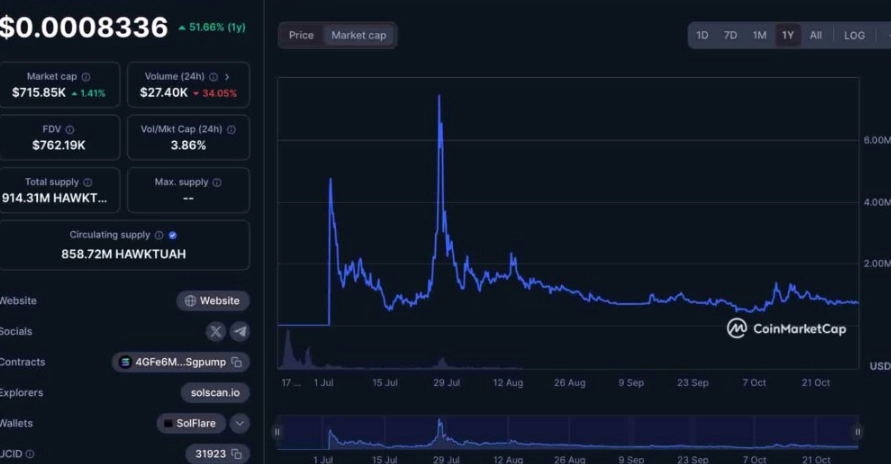
Answers to Your Burning Questions (FAQ)
Let's tackle some of the specific questions people have when they search about this topic.
It's not about better or worse; it's about different goals. Higher market cap generally means more stability and lower risk (but also lower potential for massive percentage gains). Lower market cap means higher risk and higher potential reward. A $10 million project can 100x to $1 billion. A $500 billion project (like Bitcoin) will not 100x to $50 trillion anytime soon.
Not directly, no. Anyone who says they can predict price is guessing. However, understanding coin market cap helps you set realistic expectations. It helps you see if a project is already highly valued for its stage or if it's still undervalued relative to its peers.
This is crucial. Market Cap uses the current, circulating supply. Fully Diluted Valuation (FDV) uses the total maximum supply that will ever exist. If a project has many tokens still to be released, its FDV will be much higher than its current market cap. A high FDV/Market Cap ratio is a major warning sign of future inflation.
This usually boils down to a disagreement on the circulating supply. One site's data team might classify certain locked tokens as "circulating" while another does not. This is why I stick to the major, reputable aggregators mentioned earlier—they work hard to get this right.
Putting It All Together: A Realistic Approach
When I first started, I wanted a magic formula. I wanted to find the small-cap coin that would make me rich overnight. That's a fantasy. What I've learned is that a patient, metric-driven approach works better.
Start by looking at the overall market cap of crypto to gauge the market's mood. Then, use the market cap to filter and categorize projects. A large-cap like Bitcoin might be your anchor. A couple of promising mid-caps could be your growth bets. And if you have the risk appetite, you might allocate a very small portion (money you're truly okay with losing) to research a few small-caps.
But never, ever, buy based on market cap alone. It's your primary filter, your sorting hat. Once it tells you a project is in the "Mid-Cap, DeFi" bucket, your real work begins: reading the whitepaper, checking the team, using the product, and following the community.
Final Thought: The market cap of coins cuts through the noise of price. It lets you see the forest, not just the trees. It forces you to think in terms of total value and realistic growth, which is how smart money thinks. Ignore it, and you're just hoping. Use it wisely, and you're investing.
It took me losing a bit to respect it. Hopefully, you can learn from that and use this number as the powerful tool it is.
Reader Comments