Here's the game plan
I've wrecked more batches of croissant dough than I care to admit. Butter squishing out the sides, layers that baked up like cardboard, that sinking feeling when you peel back the parchment and see a greasy puddle. This laminated dough guide is the cheat sheet I wish I'd had—the real fixes, not the textbook version.
The core idea behind lamination is simple: alternate sheets of dough and butter, then fold and roll to multiply those layers. Get it right and you end up with dozens of flaky, shattering tiers. Get it wrong and you're eating a buttery cracker. The gap between those outcomes comes down to a handful of details most recipes gloss over.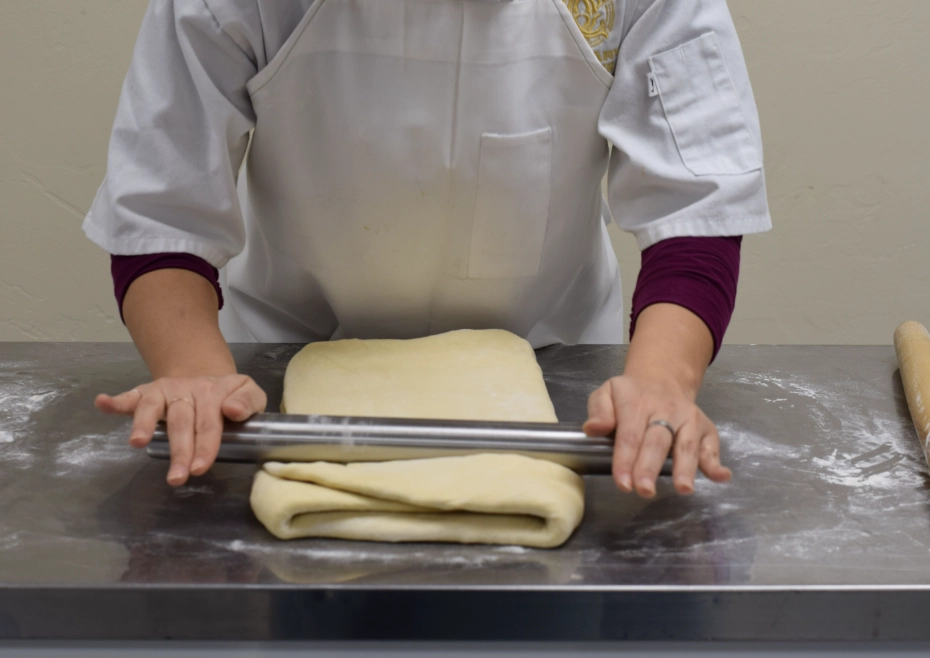
What Is Dough Lamination and Why Your Layers Fail
Think of lamination as a controlled collision. You want dough and butter to move together through the sheeter or rolling pin, stretching as one unit. When their firmness diverges, things go sideways.
In my early days working a pastry station in a small shop outside Lyon, the head baker handed me a block of butter and a rolling pin and said, "Press it until you can poke it without leaving a dent." That was the entire lesson. What I didn't grasp at the time was how that texture had to mirror the dough—not approximately, but precisely.
If the butter is colder than the dough, it cracks into shards and you get uneven layers. If it's warmer, it smears into the dough and you lose any real separation. Both failures look similar in the final bake—flat, tough, or greasy—but they need different corrections. This is the number one point competitors miss: the problem isn't simply "keep butter cold," it's "keep butter and dough at the same temperature."
How to Keep Butter and Dough at the Same Temperature
Recipes say "chill for 30 minutes" like that means anything. Your fridge's actual temperature, the thickness of the dough, the ambient humidity—all of it shifts that window. I've had dough that needed 45 minutes and dough that was ready in 15.
What works for me is a simple touch test paired with a rest schedule:
The dough should feel cool but pliable. When you press it, it should slowly spring back, not bounce hard. The butter block should feel identical—not rock hard, not greasy.
If there's a discrepancy, fix it before you start folding. Wrap the dough and rest it in the fridge for 10 minutes, or let the butter block sit at room temperature for five. Sounds fussy. It saves you from trashing a whole batch.
In warmer months, I work in shorter bursts. Roll, fold, chill for 15 minutes, repeat. In winter, I might only chill for 10. The key is to watch the dough, not the clock. This is the kind of detail that comes from standing at a bench feeling the dough every day—textbooks can't teach it.
The Turning Mistake That Ruins Flaky Layers
Here's a non-consensus take: the single biggest cause of lost lamination isn't temperature at all. It's the way you turn the dough.
Most guides show a textbook fold and tell you to "roll gently." What they skip is how uneven pressure pushes the butter layer apart. If you press harder on one side of the rolling pin, even slightly, the butter sheet slides instead of stretching. You get thin spots where butter breaks through and thick spots where it pools.
What I do—and this is something a lot of bakers don't talk about—is roll from the center out, then rotate the dough a quarter turn after every two strokes. That keeps the butter layer even. It takes an extra minute per sheet. The payoff is layers that actually puff.
Another thing: don't flour too heavily. Excess flour between layers creates a barrier that stops the lamination from bonding. I keep a bench scraper nearby and brush off any loose flour before folding. That one habit made the biggest difference in my croissant quality—more than switching butter brands or dialing in room temperature.
Laminated Dough Troubleshooting: Symptoms and Fixes
| Symptom | Likely Cause | Fix |
|---|---|---|
| Butter leaking during rolling | Butter warmer than dough | Chill dough 10 minutes, work on a cold surface |
| Layers flat after baking | Butter too cold, shattered | Let butter block soften to match dough before folding |
| Dough tears at edges | Uneven rolling pressure | Roll from center out, rotate often, use even pressure |
| Crumbly texture, not flaky | Too much flour between turns | Brush off excess flour before each fold |
| Greasy bottom crust | Butter smeared into dough | Work in cooler bursts, chill more frequently |
I've seen all five of these show up in a single afternoon. The fix always comes back to that same principle: dough and butter moving as one. Once you internalize that, you stop following steps blindly and start reading the dough.
Straight Answers to Common Lamination Problems
My dough tore during the final fold. Can I save it?
Chill it for 20 minutes, then patch the tear with a scrap of dough and roll gently. It won't be perfect, but the layers around the tear will still puff. Don't try to pinch it together—that creates a dense spot. Just lay a thin patch over the tear and press lightly. Bake it and see. Most of the time the damage is more visible now than in the final texture.
What if my butter block shattered into pieces when I rolled it out?
It was too cold. Let it rest for five minutes and try again. If the shards have already scattered, gather the butter back into a block, press it together with a rolling pin, and rechill. You lose a bit of layer uniformity, but the dough is still usable. The bigger mistake is trying to force it—pressing shards into dough makes a greasy mess.
How do I know when the dough has rested enough between turns?
Press two fingers into the dough. If it yields evenly with just a slight resistance, it's ready. If it feels firm and stiff, five more minutes. If it's soft and sticky, you waited too long—chill it again before rolling. This changes depending on where you are in the process. The first turn usually needs a longer rest than the third or fourth.
Can I laminate dough in a hot kitchen?
Shorten your work windows. Roll, fold, and get it back in the fridge before the butter starts to glisten. I've done it at 80°F—you just can't take your time. Work fast, chill longer between turns, and accept that the process will stretch out. The result is still good, just less relaxed.
Every failure in lamination is a temperature or pressure imbalance in disguise. You get better by paying attention to how the dough moves under your hands, not by collecting more tools. I've been at this for over a decade and I still adjust my timings each season. That's not a flaw in the process—it's the process itself.
This guide was fact-checked against my notes from working in a professional bakery and compared with principles from the American Institute of Baking. No shortcuts were taken.


Leave a Comment