Key Sections at a Glance
- What Is Bitcoin Dominance, Really? (Beyond the Basic Definition)
- The Historical Rollercoaster of BTC Dominance
- Why Should You Even Care About This Number?
- The Big Factors That Push and Pull on Dominance
- How to Actually Use BTC Dominance in Your Strategy (Without Getting Rekt)
- The Limitations and Criticisms (The Stuff Fanboys Don't Talk About)
- Your Bitcoin Dominance Questions, Answered
- Wrapping It Up: Your New Lens on the Market
Let's be honest. The crypto market can feel like a chaotic mess sometimes. Thousands of tokens, wild price swings, and new jargon popping up every week. It's enough to make your head spin. But there's one metric that cuts through the noise, one number that old-school Bitcoiners and degen altcoin traders alike keep an eye on. It's called Bitcoin dominance, or BTC dominance for short.
You've probably seen the chart. That line that seems to tell a story about who's winning the crypto war at any given moment. Is Bitcoin calling the shots, or are the altcoins having their moment in the sun?
I remember the first time I really paid attention to it. It was late 2017, and everyone was talking about altcoins. Ethereum was flying, ICOs were printing money, and Bitcoin? It felt almost... old news. But that BTC dominance chart was telling a different story. It had been dropping for months, hinting that maybe this altcoin frenzy couldn't last forever. And it didn't. The crash came, and Bitcoin reasserted its throne. That's when I realized this wasn't just another random percentage. It was a pulse check on the entire market's psychology.
But here's the thing nobody tells you upfront: BTC dominance is a deeply misunderstood indicator. People treat it like a crystal ball, which it absolutely is not. It's more like a weather vane, showing you which way the wind is blowing, but not if a storm is coming.
So, what's the real story behind this famous metric? Let's dig in.
What Is Bitcoin Dominance, Really? (Beyond the Basic Definition)
Okay, you know the formula: (Bitcoin's Market Cap / Total Crypto Market Cap) * 100. But where does that data even come from? This is where it gets interesting, and a little messy.
The go-to source for most people is CoinMarketCap. It's the granddaddy of crypto data sites, and its dominance chart is the industry standard. You'll also find it on CoinGecko. But here's a pro tip: the numbers between sites can sometimes differ slightly. Why? It comes down to which coins they include in their "total market cap" calculation.
Does a meme coin with a $50 million market cap really belong in the same calculation as Bitcoin? Sites have different listing criteria, which can tweak the total market cap figure, and thus, the final BTC dominance percentage. It's a small difference usually, but it's worth knowing.
Now, let's talk about what it actually measures. It's not a measure of Bitcoin's health in isolation. A rising Bitcoin dominance doesn't automatically mean Bitcoin is performing spectacularly. It could mean Bitcoin is holding steady while altcoins are crashing hard. Conversely, a falling BTC dominance could mean altcoins are mooning while Bitcoin is flat, or it could even happen while Bitcoin itself is rising, just not as fast as everything else.
See the nuance? That's what most beginner guides miss.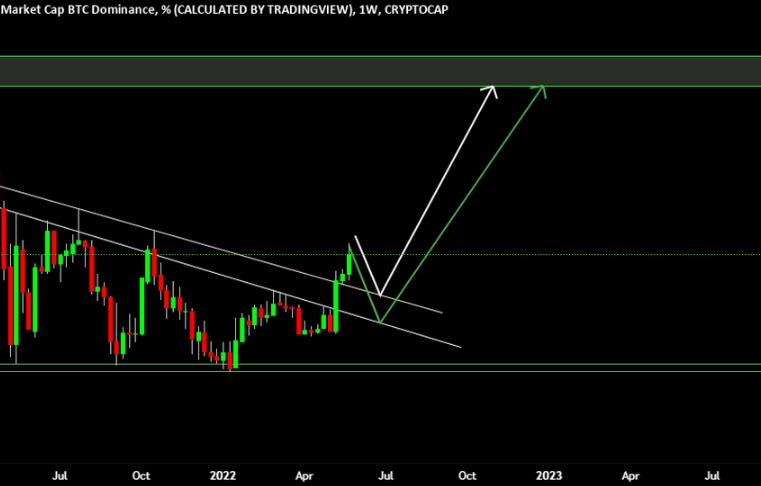
The Historical Rollercoaster of BTC Dominance
To understand where we might be going, you have to look at where we've been. The history of Bitcoin dominance is a wild ride that mirrors the evolution of the crypto space itself. It's not just numbers on a chart; it's a narrative.
In the very beginning (we're talking 2010-2013), Bitcoin dominance was basically 100%. There was no other game in town. The concept of an "altcoin" was just emerging.
The first major shift happened with the rise of Litecoin and the early privacy coins. For the first time, Bitcoin's share of the market dropped below 90%. It was a sign that people were looking for alternatives, for coins that offered something different—faster transactions, more privacy.
But the real game-changer was Ethereum. Its launch in 2015 and the subsequent ICO boom of 2017 fundamentally altered the landscape. For the first time, you didn't just have alternative currencies; you had an entire alternative ecosystem for building applications. This sparked the first true "altcoin season." Investors flooded into thousands of new tokens, chasing astronomical returns. Bitcoin's dominance plummeted.
Take a look at this snapshot of key historical levels. It tells a story of boom, bust, and consolidation.
| Period | Approximate BTC Dominance Range | Market Context & "Story" |
|---|---|---|
| Early Days (Pre-2014) | > 90% | Bitcoin is cryptocurrency. No significant competitors. |
| First Altcoin Wave (2014-2016) | 70% - 90% | Litecoin, XRP, early privacy coins gain traction. The idea of an "alternative" to Bitcoin takes root. |
| ICO Mania & Peak (2017- Early 2018) | All-time low area (~35%) | Ethereum ecosystem explodes. "Altcoin season" in full effect. Speculation runs rampant on new tokens. Bitcoin is seen as slow and old-fashioned. |
| Crypto Winter (2018-2019) | Climbing back to ~70% | ICO bubble pops. Money flees risky altcoins and runs back to the perceived safety of Bitcoin. "Flight to quality." |
| DeFi Summer & Institutional BTC (2020-2021) | Fell from ~70% to ~40% | A tale of two halves. First, DeFi on Ethereum creates a new altcoin frenzy. Then, institutional buying (think MicroStrategy, Tesla) pushes Bitcoin to new highs, lifting dominance temporarily before altcoins catch up. |
| Post-FTX Crash & Present (2022-Now) | Consolidating ~50% - 55% | Market shock from collapses (LUNA, FTX) causes another flight to Bitcoin. It has stabilized around the halfway mark, suggesting a more mature, balanced market where Bitcoin is the bedrock but altcoins have a permanent seat at the table. |
That crash from the 2017 highs was brutal for altcoin holders. I saw portfolios get decimated. It was a harsh lesson: when fear hits the market, Bitcoin's dominance often rises. Traders don't just sell altcoins for dollars; they often sell them for Bitcoin, believing it's the safest harbor in a storm. This "flight to safety" or "flight to quality" is one of the most reliable patterns in the BTC dominance chart.
Why Should You Even Care About This Number?
Fair question. You're busy. You're looking at charts, reading news, maybe even trying to have a life outside of crypto. Why add another metric to the pile?
Think of it as context. Reading a price chart for Solana or Chainlink without knowing the broader BTC dominance trend is like trying to forecast the weather by looking at a single tree. You might get lucky, but you're missing the big picture.
It's a Gauge of Market Sentiment and Risk Appetite
This is its superpower. A rising Bitcoin dominance typically signals a risk-off environment. Investors are nervous. They're pulling money out of riskier, more speculative altcoins and parking it in what they perceive as the safer, more established asset: Bitcoin. This often happens during bear markets, periods of high uncertainty, or after major negative news events (like an exchange collapsing).
A falling Bitcoin dominance usually signals a risk-on environment. Greed is in the air. Investors are confident and hungry for bigger returns. They're willing to take on the extra risk of altcoins, betting that these smaller, more volatile projects will outperform Bitcoin. This is the fuel for what everyone calls "altcoin season."
It's not perfect, but it's one of the best single indicators we have for this psychological shift.
It Can Hint at Potential Market Cycles
Traders look for patterns. One common narrative is that bull markets often start with Bitcoin leading the charge. Money flows into crypto, and the big, recognizable name (BTC) gets the first wave of investment. Its dominance rises.
Then, as the bull market matures and investors get more comfortable, they start to look further down the risk curve. They take profits from Bitcoin and rotate them into altcoins, hoping for 10x or 100x gains. This causes Bitcoin's dominance to fall while altcoins surge.
The cycle often ends with a speculative frenzy in altcoins (and meme coins), which coincides with a low point in BTC dominance. When that frenzy pops, the cycle reverses: money flows back to Bitcoin, and its dominance climbs again.
Recognizing which phase of this loose cycle we might be in can inform your strategy. Are you early or late?
It's a Tool for Relative Strength Analysis
This is a more advanced, but incredibly useful, way to use it. Let's say Bitcoin goes up 5% this week. That's good, right? But what if, in the same week, the total crypto market cap went up 10%? That means Bitcoin actually underperformed the broader market. Its relative strength was negative, even though its price went up.
A falling BTC dominance in an up market confirms that altcoins are outperforming. A rising dominance in a down market confirms that Bitcoin is falling less hard than everything else (it's holding up better). This kind of analysis helps you pick stronger assets within the trends.
The Big Factors That Push and Pull on Dominance
So what actually moves the needle? It's not random. Several major forces are constantly tugging on the bitcoin dominance chart.
- Bitcoin-Specific News & Adoption: A major country adopting it as legal tender? A huge corporation adding it to their balance sheet? A positive regulatory decision in the US? These events directly boost demand for Bitcoin, often leading to a spike in its dominance as money flows in. The 2021 surge to $64k, supported by institutional announcements, saw dominance rise sharply.
- Altcoin Innovation & Narratives: Remember "DeFi Summer" 2020? That was an Ethereum/altcoin narrative so powerful it sucked billions away from Bitcoin. More recently, narratives around Solana's resurgence, the rise of new L2s, or meme coin mania can cause sharp drops in BTC dominance. When a new, hot thing captures everyone's imagination, money follows.
- Macroeconomic Conditions: This is huge, and often overlooked. When interest rates rise and traditional markets (stocks) sell off, crypto often follows. But Bitcoin, with its "digital gold" narrative, can sometimes be seen as a better hedge than smaller altcoins during these times. This can cause a paradoxical rise in Bitcoin dominance even as its price falls, because altcoins fall more.
- Liquidity and Market Crises: This is the "flight to safety" effect in its purest form. When a major crypto lender or exchange blows up (think Celsius, FTX), panic ensues. Traders don't just cash out to dollars; they rush into Bitcoin as the most liquid and resilient asset. We saw a dramatic spike in Bitcoin dominance after the FTX collapse in late 2022.
- The Halving Cycle: This one is more theoretical and long-term. The Bitcoin halving (the event that cuts new coin issuance in half) creates a built-in supply shock narrative. Some believe this event focuses immense attention and bullish pressure specifically on Bitcoin in the months surrounding it, potentially boosting its dominance relative to assets without such a predictable, scarcity-driven catalyst.
It's a constant tug-of-war between these forces. Right now, for example, we might see Bitcoin dominance supported by the spot ETF flows in the US (a huge adoption win) but pressured by frenetic activity in the Solana meme coin scene or new Ethereum L2 airdrops.
How to Actually Use BTC Dominance in Your Strategy (Without Getting Rekt)
Okay, theory is great. But how do you turn this into actionable insight? Let's get practical. I'm not a financial advisor, this isn't advice, but here's how I and many others think about it.
First, don't use it as a standalone buy/sell signal. This is the biggest mistake. Seeing dominance hit 55% does not mean "SELL ALTCOINS NOW." It's a context provider, not a crystal ball.
Here’s a framework I find useful:
- Determine the Trend: Is the BTC dominance chart in a clear uptrend, downtrend, or ranging? Use simple tools like moving averages (e.g., the 200-day MA) to smooth out the noise. A dominance chart above its key moving averages suggests strength; below suggests weakness. This tells you the prevailing wind.
- Gauge the Momentum: Is the move sharp and fast, or slow and grinding? A rapid spike in dominance often indicates a panic event (risk-off). A slow, steady decline might indicate a healthy rotation into altcoins (risk-on). The speed can tell you about the intensity of the sentiment shift.
- Combine with Other Data: Never look at dominance in a vacuum. Cross-reference it.
- With Bitcoin's price trend: Is Bitcoin going up with rising dominance (strong BTC-led rally)? Or is Bitcoin going down but dominance is rising (altcoin crash/flight to safety)?
- With Total Market Cap (TOTAL): Is the total market cap growing while dominance falls? That's a classic, healthy altcoin season sign (a rising tide lifting all boats, but altboats more). Is total market cap falling while dominance rises? That's a clear risk-off, capital-flight scenario.
- With On-Chain Data: Sites like Glassnode offer deep data. Are Bitcoin whales accumulating while dominance rises? That's a strong sign of conviction.
- Inform Your Asset Allocation: This is the endgame. In a strong BTC dominance uptrend (risk-off), you might want to be overweight Bitcoin in your portfolio. Maybe you take some profits on altcoins that have run too far. In a strong BTC dominance downtrend (risk-on), you might feel more confident allocating a portion of your portfolio to high-conviction altcoins, knowing the market wind is at their back.
Let me give you a personal example. In early 2023, after the FTX disaster, Bitcoin dominance had spiked hard and was consolidating at a high level while the total market cap was flat. The sentiment was awful. But the dominance chart started to slowly, subtly roll over. It broke below a key moving average. At the same time, Bitcoin started a slow grind up. This combination—falling dominance in a rising total market—was a textbook early signal of money starting to rotate out of safety and into risk. It was one of several signals that gave me the confidence to start DCAing into a few select altcoins again, which paid off handsomely later in the year.
The flip side? I've also been burned ignoring it. Chasing an altcoin pump when dominance was in a violent spike upward has led to quick, painful losses.
The Limitations and Criticisms (The Stuff Fanboys Don't Talk About)
No indicator is holy, and Bitcoin dominance has some serious flaws. It's important to know its weaknesses so you don't get blindsided.
1. The "Total Market Cap" is a Fiction. This is the big one. The total crypto market cap is calculated by adding up (price * circulating supply) for every listed coin. This is problematic for coins with massive, mostly unused supplies. It can inflate the total market cap number, which in turn artificially lowers the Bitcoin dominance percentage. Some people argue for a "liquid market cap" or adjust for clearly inflated supplies, but there's no standard for this.
2. It Treats All Altcoins as One Blob. Ethereum is not Dogecoin. A drop in dominance could be because institutional money is flowing into Ethereum (a quality shift) or because of a speculative pump in a useless meme coin (a junk shift). The metric doesn't differentiate. You need to look under the hood.
3. The Rise of Stablecoins. Stablecoins like USDT and USDC now make up a massive portion of the total market cap. They are not competitors to Bitcoin in terms of investment, but they are included in the denominator. Some analysts now look at "BTC Dominance ex-Stablecoins" to get a clearer picture of Bitcoin's share among purely volatile assets. This can tell a very different story!
4. It's Backward-Looking. Like most technical indicators, it tells you what has happened, not what will happen. By the time a trend in dominance is clear, a big part of the move might already be over.
My personal criticism? The market has matured. In 2017, the narrative was "Bitcoin vs. Altcoins." Today, it's more nuanced. It's "Store-of-Value Bitcoin vs. Smart Contract Platform Ethereum vs. Niche Altcoins." A simple dominance chart struggles to capture this multi-dimensional battle.
Your Bitcoin Dominance Questions, Answered
- CoinMarketCap Charts
- CoinGecko Global Charts
- TradingView (search for "TOTALBTC" or "BTCD" on the chart)
Many portfolio trackers and exchanges also display it on their market overview pages.
Wrapping It Up: Your New Lens on the Market
So, where does this leave us? Bitcoin dominance isn't a magic key to unlock infinite crypto profits. Anyone who tells you that is selling something.
But it is an incredibly valuable lens—a way to understand the underlying currents of fear and greed, of risk-on and risk-off, that drive this wild market. It forces you to think in terms of relative strength and market structure, not just absolute price.
Start by simply watching it. Add the chart to your dashboard. Observe how it moves when big news hits. See how it interacts with Bitcoin's price and the total market cap. Over time, you'll develop a feel for what its movements mean.
Use it as one tool among many. Combine it with on-chain data from places like Bitcoin.org resources or analytics platforms, with macroeconomic trends, and with solid fundamental research on individual projects.
Remember its flaws.
Respect its history.
And maybe, just maybe, it'll help you spot the next major shift in the wind before everyone else does. Not as a crystal ball, but as a seasoned sailor reading the sky and the waves. That's the real power of understanding BTC dominance.
Reader Comments